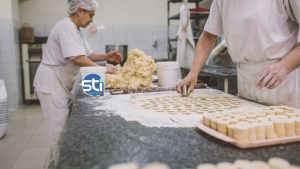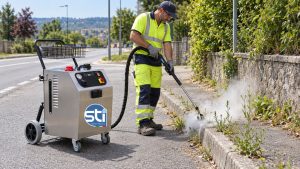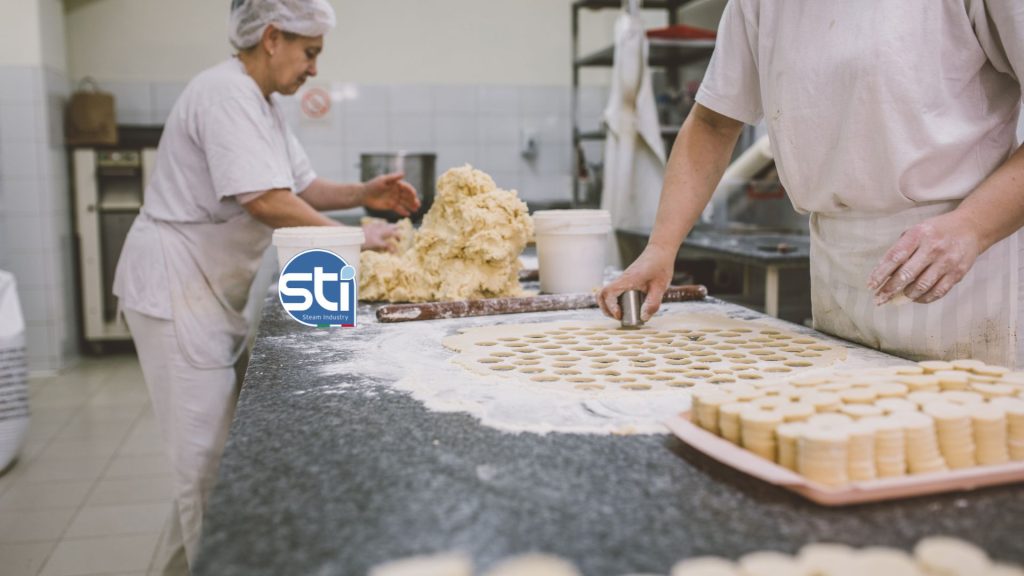
Hygiene in bakeries and pastry shops calls for constant attention, because the same space has to accommodate such a wide range of different processes: dough, flour, sugar, creams, fats, baked goods and products ready for sale. This is exactly why dry saturated steam can become a valuable tool within the cleaning procedures a bakery or pastry shop already has in place. Its high temperature helps dissolve clinging dirt and greasy residue, while its low water content makes it possible to work on many compatible surfaces without resorting to the volumes of water typical of traditional washing.
Hygiene in Bakeries and Pastry Shops: Everyday Challenges
A bakery or pastry workshop has needs quite different from an ordinary kitchen. Flour tends to spread and build up even in the least accessible corners; sugar, creams and dough can dry onto surfaces; butter, oils and other fats leave behind residue that calls for genuine degreasing action.
This is why sanitising bakeries and pastry shops needs to be organised by zone, by material and by the type of dirt involved. The HACCP self-monitoring system sets out the procedures needed to keep hygiene and food-safety risks under control, and within that framework, steam can be integrated into the cleaning of compatible surfaces. The same approach applies more broadly to sanitising the food and beverage industry, where hygiene in production environments, equipment and work areas calls for consistent, targeted procedures.
Allergens, Pests and Mould: Three Aspects Not to Overlook
In bakeries and pastry shops, cleaning isn’t just about visible dirt. Certain issues deserve particular attention precisely because they’re directly tied to the variety of processes at work and to the conditions typical of this kind of workshop.
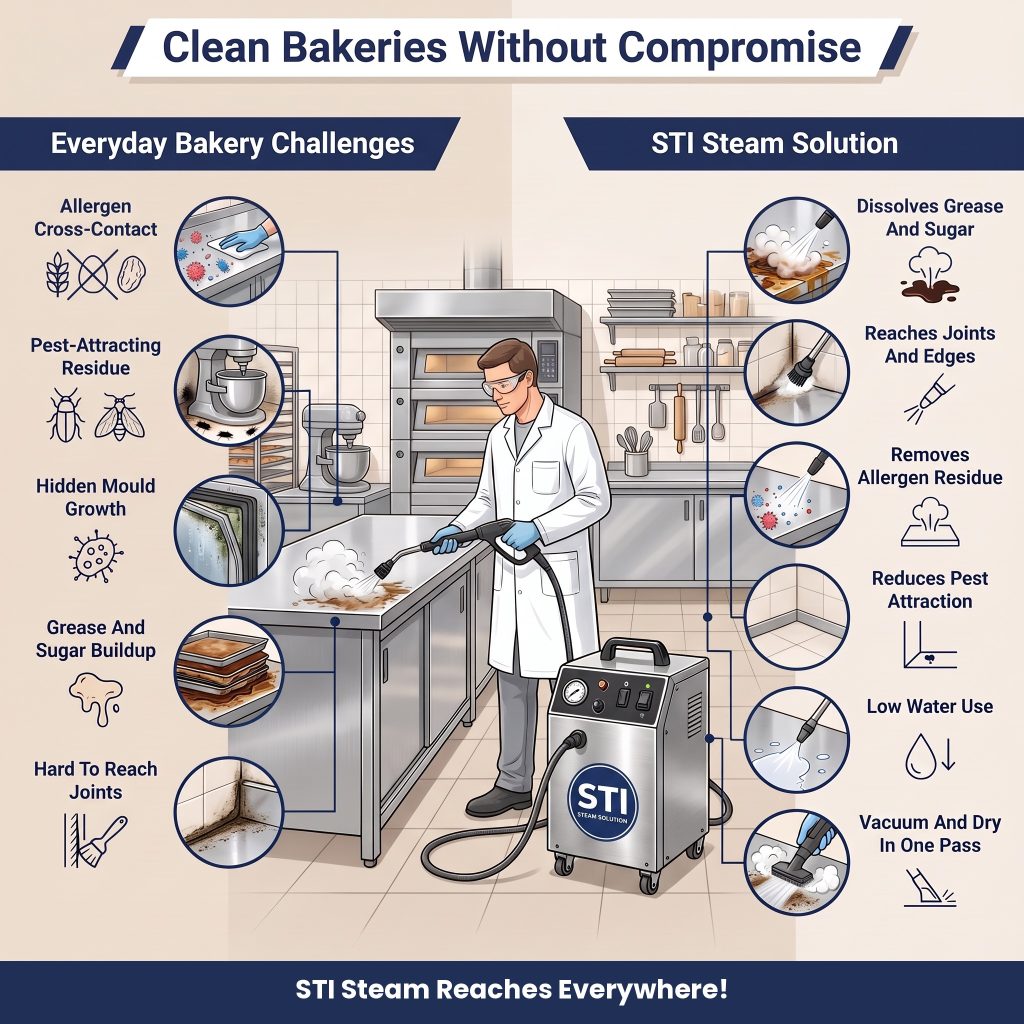
- Allergen residue: gluten, tree nuts, eggs and milk may all be used in different preparations on the same counters or with the same equipment, which makes thorough cleaning between one process and the next essential. Steam helps remove food residue that may contain allergens, including from joints, edges, crevices and other spots that are hard to reach with traditional cleaning methods.
- Residue that attracts pests: flour, crumbs and raw ingredients left in corners, under counters or near equipment can create favourable conditions for pests such as Indian meal moths and flour beetles. Thorough vacuuming and cleaning of the less accessible spots helps reduce the food residue that can attract these insects and keeps work areas cleaner overall. Where an infestation is already underway, however, cleaning alone isn’t enough: specific monitoring and pest-control protocols need to be followed.
- Mould in warm, humid areas: gaskets, proving chambers and zones prone to humidity and condensation call for regular checks and cleaning. Steam reaches into crevices, edges and surfaces that are difficult to treat by hand, helping to remove the dirt and build-up that can encourage mould growth.
Where to Use Steam in a Bakery or Pastry Shop
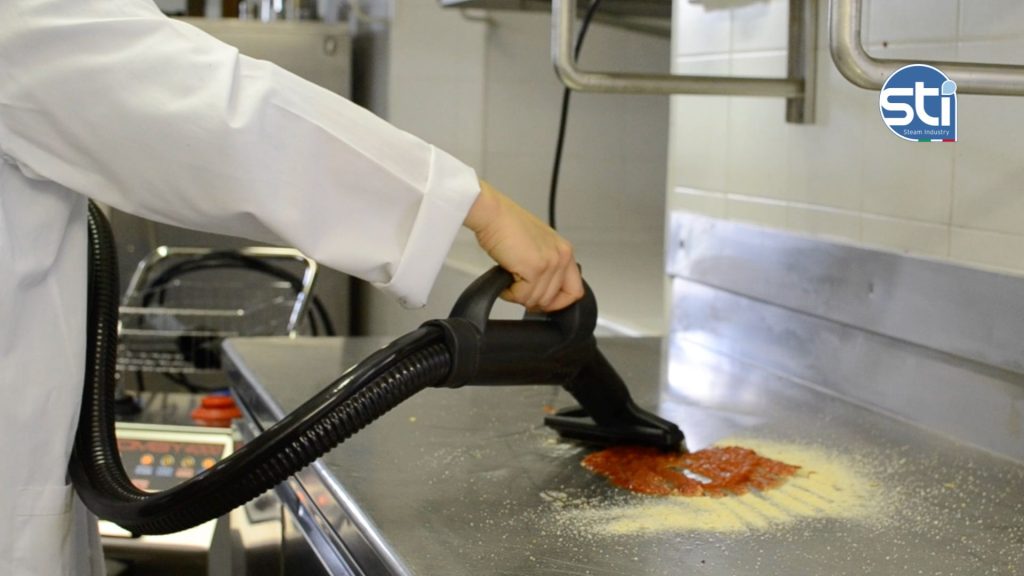
- Counters and work surfaces: the stainless-steel worktops and other washable surfaces in the workshop are subject to intense daily use. Steam works on flat areas, but especially on edges, joints, trim, feet and all the spots that sponges and cloths struggle to reach. Thorough cleaning of these surfaces becomes particularly important when the same counter is used for preparations containing different allergens.
- Trays, racks, trolleys and compatible utensils: dough residue, fats and cooked sugars can cling to the trays, racks and trolleys used during production. The heat of the steam helps soften the dirt, making it easier to remove afterwards. Brushes and lances also make it possible to work on edges, wheels and runners.
- Floors, grouting and corners of the workshop: in cleaning bakeries and pastry shops, the floor deserves particular attention, since flour, crumbs, sugar and other process residue tend to be a constant presence. In this context, steam cleaners with integrated vacuum prove especially practical, since a single machine can both collect solid debris and carry out the steam treatment that follows. Once the coarser dirt has been vacuumed up, the steam can act on clinging residue, grout lines, edges and hard-to-reach spots, while the vacuum collects loosened dirt and residual moisture, making the job quicker and tidier.
- Display cases, glass and sales-area surfaces: hygiene isn’t confined to the workshop alone. Display cases, glass, washable surfaces and display areas all contribute directly to how clean customers perceive the shop to be. With the right accessories and properly adjusted flow, steam can remove fingerprints and dirt from many compatible surfaces while keeping water input to a minimum.
- Refrigerators, blast chillers and proving chambers: gaskets, handles, edges and gaps are among the spots where dirt and residue tend to build up most easily. In proving chambers, in particular, the combination of heat and humidity makes regular surface cleaning especially important. Steam allows for targeted intervention even in the least accessible areas, and the same approach is also used in sanitising cold rooms, where joints, gaskets and contact points call for constant attention.
What About the Oven? A Specific Cleaning Approach Is Best
The oven is a case apart. Inside it, charred residue, grease and scale build up after repeated exposure to high temperatures, raising issues quite different from those of counters, floors or display cases: a dedicated in-depth guide on how to clean an industrial oven is available.
How to Properly Organise Steam Cleaning in the Bakery Sector
In a bakery or pastry shop, cleaning shouldn’t follow a single procedure for the entire workshop. Flour, sugar, fats, creams and dough residue all behave differently and call for different accessories, steam intensity and working methods. To make the work more effective, it therefore pays to organise interventions by zone and by type of dirt.
- Start with areas that have dry residue: on floors and production zones where flour, crumbs and sugar accumulate, a steam cleaner with vacuum lets you collect the coarser debris first and then use steam with the same machine. Keeping corners, under-counter areas and hidden spots clean also helps avoid the kind of food build-up that can attract pests.
- Adapt the treatment to the type of dirt: greasy residue, dried creams, clinging dough or caramelised sugar all call for a more targeted action. In these cases, it’s worth working with lances, brushes or other specific accessories, giving the heat the time it needs to soften the dirt before removal.
- Take changeovers between preparations into account: when the same counters or tools are used for different recipes, cleaning also needs to factor in the possible presence of residue from allergen-containing foods. Steam can support its removal from compatible surfaces, as part of the procedure the business already has in place.
- Work from the work surfaces down towards the lower areas: counters, equipment and vertical surfaces can be treated before the floors, so that any residue that falls during cleaning can be collected afterwards. It’s a simple sequence that avoids having to go back over the same areas more than once.
- Pay particular attention to joints and awkward spots: counter edges, grout lines, trolley wheels, runners, gaskets and gaps are all areas where dirt tends to accumulate. A concentrated steam jet reaches these spots with far more precision than a simple pass with a cloth or sponge.
- Finish with collection and drying: when using a model with integrated vacuum, loosened dirt and residual moisture can be removed directly during the treatment itself. Before production resumes, it’s still worth checking that surfaces are clean, dry and ready for use, in line with the business’s own procedures.
In this way, steam in the cleaning of bakeries and pastry shops isn’t used as a blanket, one-size-fits-all solution, but as part of an organised method that takes into account the real characteristics of the workshop, the dirt actually present, and the different surfaces to be treated.e tiene conto delle caratteristiche reali del laboratorio, dello sporco presente e delle diverse superfici da trattare.
Which Steam Cleaner Should You Choose for Bakeries and Pastry Shops?
The right choice depends on the size of the workshop, how often cleaning takes place, and how long each session lasts. The STI Steam Industry range makes it possible to find the right solution, whether for a small artisan workshop or a larger-scale production facility.
Small Workshops: Gaiser 2000 and QV7 PRO
For bakeries, pastry shops and small workshops looking for a compact professional solution, Gaiser 2000 is a particularly versatile entry-level option: a single-phase generator with a stainless-steel body, 6 bar of pressure and a steam output of 100 g/min. The Non-Stop System allows the water to be topped up without waiting for the boiler to cool down, a feature that’s useful for everyday work too.
When vacuum is wanted alongside steam cleaning, QV7 PRO is a well-suited solution for small professional businesses. It works at 7 bar, produces 100 g/min of steam and integrates a 1200 W vacuum system: technologies such as Dry-Master and Infini-Vac make it possible to collect loosened dirt and adjust suction according to the surface being treated.
Medium-to-Large Workshops: Gaiser 4000 and Comby 4000
For workshops and businesses with more intensive needs, the STI Professional Line offers more powerful single-phase solutions. Gaiser 4000 is a generator with a stainless-steel body, 8 bar of pressure and steam output of up to 125 g/min: a solution best suited to those looking, above all, for a powerful, adjustable steam jet. Among its available technologies, Dose-Master allows detergent to be dosed electronically when needed, while Hydro-Jet makes it possible to add water to the steam to ease treatment and the rinsing away of more stubborn dirt.
Comby 4000 steps up to 10 bar and 130 g/min, and integrates a 1400 W vacuum function. For a bakery or pastry shop, it’s particularly useful when, beyond dissolving dirt, there’s also a need to collect residue and moisture in the same cycle. The Dry-Master system allows the treated surfaces to be vacuumed and dried, while Infini-Vac makes it possible to adjust suction power according to need.
Industrial Line: Gaiser 9000 and Comby 9000
For larger production workshops, or for businesses running extended cleaning sessions, it makes more sense to consider the STI Industrial Line. Gaiser 9000 is a three-phase generator running at 10 bar with an output of 288 g/min, designed for the most demanding industrial applications. The Non-Stop System allows for continuous topping-up without interrupting work, and with the Hydro-Power option, the machine can be connected directly to the mains water supply to handle long-duration sessions.
Comby 9000 keeps the same pressure and steam output figures as the Gaiser 9000, at 10 bar and 288 g/min, while adding a 1400 W vacuum system. Like its Professional Line counterpart, the Comby 4000, it also integrates the Dry-Master and Infini-Vac technologies: features that are particularly appealing when sanitising bakeries and pastry shops involves extensive production areas and is carried out at high frequency.
STI Steam Industry Solutions for the Food Sector
STI Steam Industry develops steam generators for professional and industrial applications, including models designed specifically with the food sector in mind. From the small artisan workshop to larger-scale production, the choice between a steam-only machine and a solution with vacuum should start from the real working conditions involved: the size of the space, the type of dirt, how often cleaning takes place, whether single-phase or three-phase power is available, and the need to work for extended periods. To find the generator best suited to your workshop’s needs, get in touch with STI Steam Industry: our team can help you assess the most suitable configuration for the professional cleaning of bakeries, pastry shops and other food-production environments.
If instead you operate in the professional cleaning sector and want to broaden your offering, discover STI Steam Industry’s distribution opportunities and become part of the brand’s partner network.
FAQ on Hygiene in Bakeries and Pastry Shops
Because it combines high temperature with a low water input, helping to dissolve fats, sugars and clinging residue, while also making it possible to work on joints, grout lines and other hard-to-reach spots.
It depends on the size of the workshop and how intensively it’s used. The Professional Line includes solutions suited to small workshops too, such as Gaiser 2000 and QV7 PRO, alongside more powerful models for medium-to-large businesses. The Industrial Line, on the other hand, is designed for large surfaces, frequent cycles and extended cleaning sessions.
Steam can become a key ally in cleaning and sanitising operations, because it allows for quick, targeted action on clinging residue, grease, joints, grout lines and hard-to-reach spots. It can also support the removal of food residue between different preparations. It doesn’t replace the HACCP plan, but it can make the procedures already in place more effective, practical and better organised, especially in settings where hygiene needs to be maintained continuously throughout the working day.