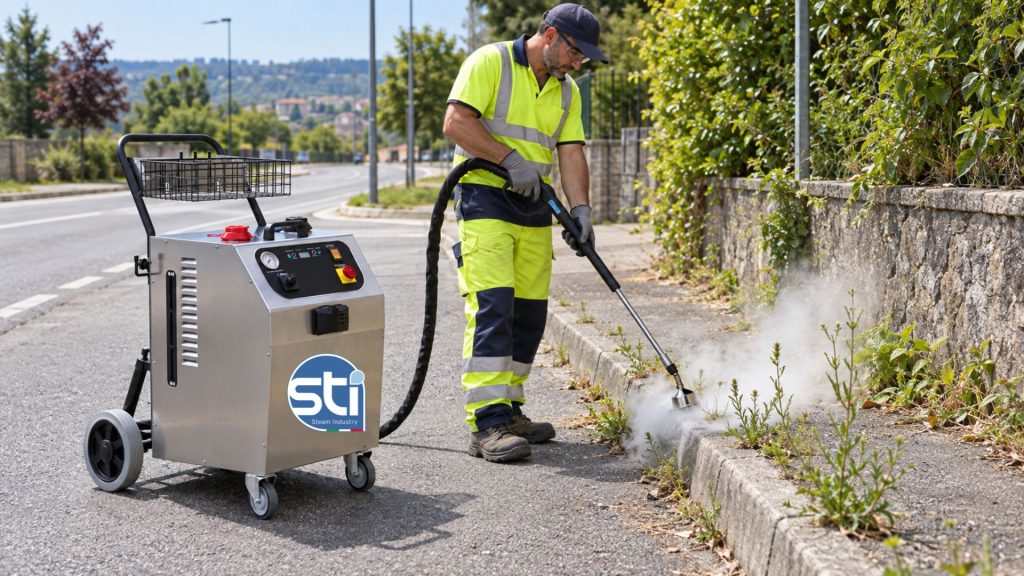
Controlling weeds along driveways, pavements, green areas and public spaces doesn’t necessarily mean reaching for herbicides. Among the physical methods available, steam weed control harnesses the power of high temperature to damage the tissue of unwanted plants and speed up their natural die-off. It’s a particularly compelling solution when you want to act in a targeted, localised way, using water purely as a heat-transfer medium, with no active substances released onto the treated surface.
What Is Steam Weed Control?
Steam weed control is a thermal method for managing invasive vegetation. Rather than applying a chemical substance that interferes with a plant’s physiological processes, the treatment rapidly transfers heat to plant tissue by means of high-temperature steam. You’ll sometimes hear the term steam herbicide, but the phrase can be misleading: there’s no herbicidal product dispersed together with the steam. The weed-killing action comes from the steam itself, and it’s entirely physical and thermal in nature. Water is converted into steam, and that heat is then directed precisely onto the vegetation you want to control.
The Manual for the Application of Minimum Environmental Criteria for Phytosanitary Treatments on Roads and Railways, drawn up under Italy’s CReIAMO PA programme to support the implementation of Ministerial Decree (D.M.) of 15 February 2017, devotes a specific section to the physical control of invasive vegetation through the application of steam. The document notes that steam weed control is already in use across a number of Italian contexts as an alternative to phytosanitary treatments in non-agricultural areas, placing it firmly among the physical (non-chemical) techniques available for weed management.
How Does Dry Saturated Steam Weed Control Work?
The underlying principle is thermal shock. When plant tissue is exposed to high temperatures for a sufficient length of time, the heat damages the cell membranes and undermines the cells’ ability to maintain their internal balance. The treated vegetation gradually loses vitality and, over the following hours or days, tends to dry out and wither. Dry saturated steam makes it possible to transfer thermal energy while keeping water input to a minimum. For weed control, the key isn’t to “burn” the plant, but to deliver heat quickly and precisely to the target plant parts. Temperature, distance, exposure time, how developed the weed is, and the application method all therefore play a part in the outcome.
Why More Than One Treatment May Be Needed
The thermal treatment acts directly, above all, on the tissue the steam actually reaches. Young, less-developed weeds tend to be more susceptible, while perennial species, already-established plants, or those with underground storage organs can send up new shoots afterwards. This is why steam weed control works best as part of a planned, ongoing programme: repeating the treatment on new growth helps progressively bring unwanted vegetation under control.
How It Compares to Other Weed Control Methods
Steam Weed Control or Chemical Herbicides?
The main difference lies in the mechanism of action. A herbicide relies on one or more active substances, while steam weed control relies on heat. As a result, the thermal treatment leaves no herbicidal residue on the surface, and is worth considering wherever there’s a wish to reduce or avoid the use of phytosanitary products. That doesn’t mean steam is automatically the best solution in every situation, though. Surface type, the size of the area, the species present, how quickly regrowth occurs, and how the work is organised all need to be weighed up together. The real advantage lies in having a physical option that can complement green-space management strategies without depending on a chemical active ingredient.
Steam Weed Control and Flame Weeding: Not the Same Thing
Both belong to the family of thermal methods, but they transfer heat in different ways. In flame weeding, the weed is exposed to the heat generated by an open flame; in steam weed control systems, by contrast, the heat carrier is steam. There’s therefore no need to bring an open flame anywhere near the vegetation or the paving. This distinction matters especially when working in urban spaces, along borders, or close to materials and structures where the presence of a flame would call for extra precautions.
Where Can Steam Weed Control Be Used?
The treatment is particularly well suited to the targeted control of weeds growing on outdoor surfaces and in spots that are awkward to manage with mechanical equipment. It’s an appealing option both for professional operators and for the bodies and organisations responsible for maintaining open, public spaces.
- Driveways, pavements and paved areas: Weeds and small shoots frequently appear in the joints between paving blocks, along kerbs, edges, joints and gravelled areas. Steam allows the treatment to be concentrated exactly where the growth is, without having to mechanically work the entire surface. On footpaths and paved areas, this makes for a precise intervention even in narrow spaces.
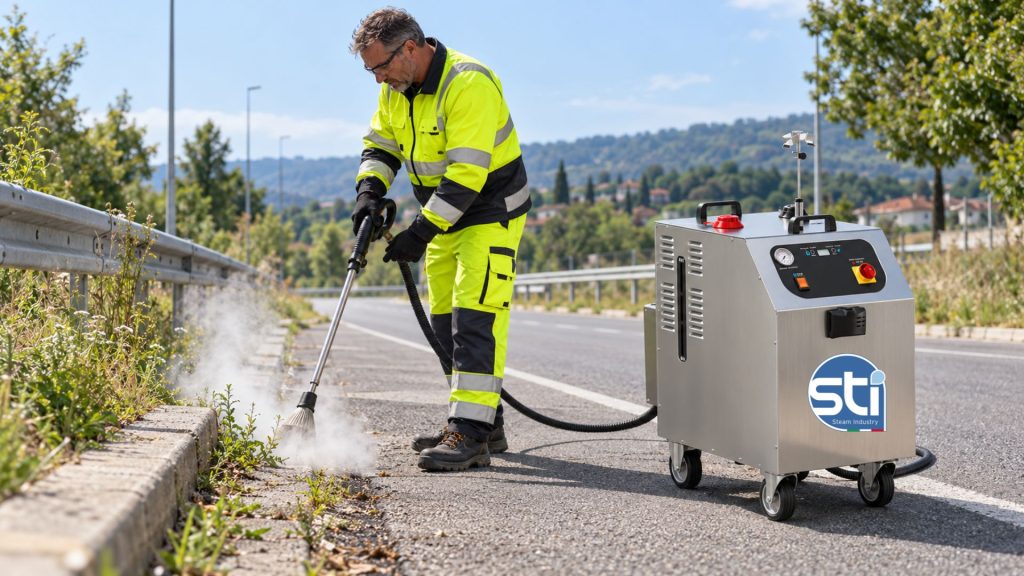
- Parks, green areas and public spaces: In public settings, weed control may need to cover paths, flowerbed margins, thoroughfares, squares and service areas. Here, steam can be one of the techniques available for managing spontaneous vegetation without releasing herbicides onto the surface. It’s essential, however, to avoid contact with ornamental plants, lawns or other species you want to preserve, since heat doesn’t distinguish between weeds and desirable vegetation.
- Cemeteries and monumental areas: Cemeteries are a classic example of an environment where weeds grow among paving, gravel, kerbs and walkways. A targeted treatment makes it possible to tackle the weeds while keeping precise control over the jet, and without applying any herbicide. The same principle can be considered for squares, car parks, rest areas and other outdoor spaces with hard or mixed surfaces.
What Are the Advantages of Steam Weed Control?
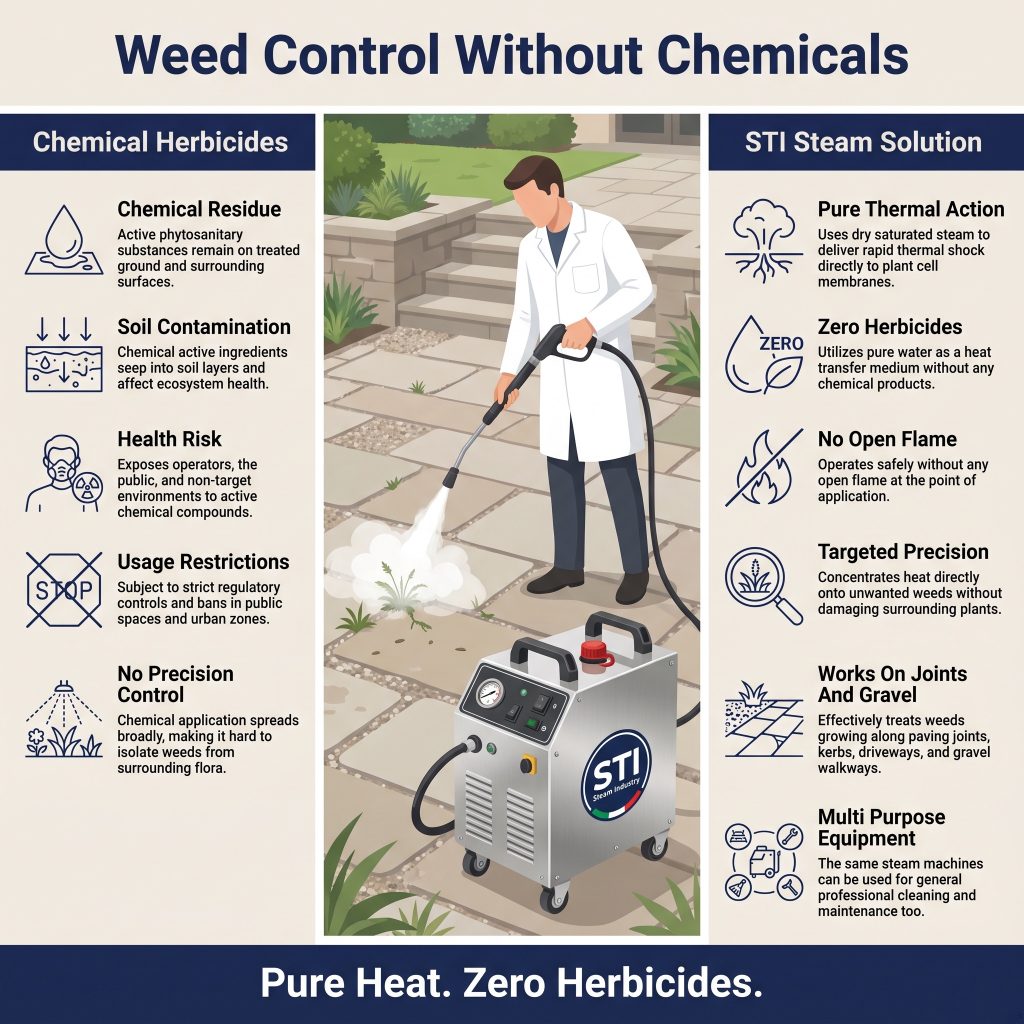
The real value of steam weed control comes above all from the ability to achieve targeted thermal action using nothing but water. Among its main advantages:
- No herbicides used during treatment;
- Targeted action on the weeds actually reached by the jet;
- No open flame at the point of application;
- The ability to work on joints, edges, gravel and a wide range of outdoor surfaces;
- The same steam technology can also be used for other professional cleaning and maintenance tasks.
This last point is particularly appealing for businesses and operators looking for versatile, multi-purpose equipment: steam isn’t a technology limited to weed control alone, but one that can be put to work across a wide range of operational contexts.
Limitations and Precautions of Thermal Steam Weed Control
To achieve an effective result, it’s important to treat steam weed control as a technical procedure, not simply a quick pass over the vegetation. Insufficient exposure may only partially damage the plant, while an uncontrolled application risks affecting species that shouldn’t be treated at all.
The possibility of regrowth also needs to be factored in. Seeds already present in the soil, new seeds carried into the area, and underground root systems can all give rise to new plants after treatment. Scheduling periodic checks and tackling weeds at the early stages of growth generally makes it possible to manage the problem in a far more orderly way than waiting for abundant growth to take hold.
Practical Tips for an Effective Treatment
In steam weed control, how the treatment is carried out matters just as much as temperature. A few practical points can help make the intervention more effective:
- Treat young weeds, when their tissue is still underdeveloped and more responsive to the thermal action;
- Choose dry days, so that rain or excessive humidity don’t interfere with the treatment;
- Work slowly and keep the jet close to the plant: in thermal treatment, exposure time is what makes the difference, so it matters far more to transfer heat properly into the tissue than to rush through the job;
- Plan for repeat treatments, especially where perennial weeds or those prone to resprouting are involved, going back in as soon as new growth appears.
STI Steam Industry and Steam Weed Control
STI Steam Industry designs and manufactures steam generators for a wide range of professional and industrial sectors. For steam weed control, especially where longer sessions are needed over large surfaces such as driveways, parks or cemeteries, the most suitable solution is the Industrial Line. In particular, Gaiser 9000 and Gaiser 18000 are steam-only industrial generators fitted with the Non-Stop System, which allows the boiler to be automatically and continuously topped up with water without ever having to stop work to refill it: a genuinely valuable advantage whenever large areas need to be treated. For longer sessions, the Hydro-Power system is also available as an option, allowing the generator to be connected directly to the mains water supply.
Want to understand how steam weed control could fit into your maintenance operations? Contact STI Steam Industry: our team can help you assess the most suitable solution based on your specific context and operational needs. STI Steam Industry also works alongside an international network of partners and distributors specialised in the professional and industrial cleaning sector: if you’re looking to broaden your offering, discover our distribution opportunities and get in touch to find out more about partnering with us!
FAQ on Steam Weed Control
No. The action of a steam herbicide, understood as a treatment system, comes from the heat transferred through the steam, not from the application of an active herbicidal ingredient.
The heat damages the tissue the treatment reaches, but some species can resprout from their roots or other underground organs. This is why repeated treatments may be necessary.
It can be used, with the appropriate precautions, on driveways, pavements, paving joints, gravelled areas, parks, public spaces, cemeteries and other outdoor surfaces wherever there’s a need for the targeted control of weeds.