Every aircraft that touches down carries with it hundreds of points of contact, well-used surfaces, recirculated air and materials under constant stress. Behind every new boarding there is an invisible but decisive process: aircraft cleaning. This is not simply a matter of tidying a cabin, but of working in a targeted way on seats, armrests, tray tables, lavatories and technical areas to guarantee high standards of hygiene, safety and comfort.
It is precisely for this reason that steam sanitisation is establishing itself as one of the most effective solutions for aircraft cleaning, combining hygienic power, speed of intervention and a reduction in the use of chemical detergents. It is a technology that answers the sector’s current priorities: efficiency, sustainability and reliability.
Why aircraft cleaning matters so much
Every day, millions of passengers travel on commercial aircraft. The interior spaces — cabins, seats, overhead lockers, lavatories, galleys — are high-footfall environments with surfaces in continuous contact with people. In this context, aircraft cleaning takes on strategic importance across three fundamental dimensions: health and safety, brand image and regulatory compliance. From a health perspective, proper aircraft sanitisation contributes to reducing bacteria, viruses and contaminants. Interior surfaces can become a vector for the transmission of micro-organisms if they are not treated with appropriate procedures and effective technologies.
From a reputational standpoint, the perception of cleanliness has a direct bearing on the passenger experience. A well-maintained cabin, free from odours and visibly sanitised, reinforces trust in the airline. Finally, there are protocols and guidelines governing aircraft cleaning, with precise standards to be met. Operations must be documentable, repeatable and safe for onboard materials and systems.
When and how aircraft cleaning is carried out
Professional aircraft cleaning is organised into several types of intervention, each with different objectives and timescales. Between one flight and the next, a rapid turnaround clean is generally carried out, focusing on waste collection, cabin reset, cleaning of the main surfaces and lavatory checks. In these cases time is the critical variable: operations must be fast but effective.
At scheduled intervals, more thorough interventions are undertaken, covering seat washing and sanitisation, fabric treatment, overhead locker cleaning and sanitisation of contact surfaces. This phase of aircraft sanitisation calls for technologies that deliver high effectiveness without damaging delicate materials such as leather, technical fabrics, electronic components and lightweight plastics. It is precisely in this context that steam cleaning demonstrates its value.
How steam sanitisation works on aircraft
Steam cleaning harnesses the combined action of temperature and pressure to remove dirt, grease, bacteria and micro-organisms from surfaces. Dry saturated steam, produced by professional steam generators, reaches high temperatures capable of dissolving soiling and reducing bacterial load without recourse to aggressive chemical substances.
In the field of aircraft cleaning, this technology offers a decisive advantage: residual moisture is minimal. Steam does not leave surfaces wet and dramatically reduces drying times. This is fundamental for avoiding interference with aircraft operating cycles. Furthermore, steam’s ability to penetrate crevices, seams and hard-to-reach areas enables deep sanitisation even at critical points such as seat joints, control panels, armrests and in-flight entertainment systems — always in accordance with the guidance issued by the manufacturers of onboard systems.
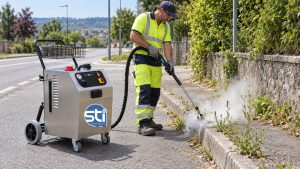
A further value-add in steam aircraft cleaning comes from steam cleaners with integrated vacuum extraction. These systems combine the sanitising action of steam with the ability to immediately extract dirt, residues and liquids. One example is the Comby 3000, a model from the Comby range fitted with DryMaster technology, which vacuums and dries the treated surface, and the Flow-Master system, which adjusts steam flow according to the surface and the type of task. This combination is particularly useful for removing crumbs, meal residues, dust and dirt trapped between seats and rails, preventing them from simply being displaced from one area to another. Simultaneous extraction makes it possible to work faster and more methodically, leaving surfaces clean and dry in a single pass — a crucial factor when turnaround times between flights are tight. For rapid, targeted interventions at the airport, a more compact Professional Line model such as the Gaiser 2000 can also prove valuable: the Click&Go system means work can begin within minutes, while SteamBooster technology combines dry steam with a secondary flow of wet steam, making it easier to dissolve and remove the most stubborn residues.
The advantages of steam cleaning over traditional methods
Traditional aircraft cleaning is often based on the use of chemical detergents and liquid disinfectants. Although effective, these products can leave residues, generate persistent odours and require longer drying times. Steam aircraft cleaning stands out for several concrete advantages.
- Reduced use of chemical products: steam performs a natural sanitising action, limiting the need for aggressive detergents. This helps improve cabin air quality and reduce the environmental impact of cleaning operations.
- Material safety: leather seats, textile coverings, plastic components and metal surfaces can all be treated with steam without risk of damage, provided the work is carried out with appropriate professional equipment.
- Operational efficiency: professional steam aircraft cleaning allows for fast, targeted intervention, reducing downtime and optimising resources.
- Odour elimination: an aspect often underestimated, yet decisive in shaping passengers’ perception of hygiene.
Sustainability and innovation in aircraft cleaning
Sustainability has become a central theme in the aviation sector. Airlines are paying increasing attention to reducing environmental impact across every stage of operations, including aircraft cleaning. Steam aircraft sanitisation fits perfectly into this picture. Reduced use of chemical products, lower water consumption compared with traditional methods and the ability to limit waste and packaging make steam a technology fully consistent with ESG objectives. Technological innovation now makes it possible to use steam cleaners that are compact, high-performing and designed for complex professional environments such as airports and maintenance hangars.

The role of STI Steam Industry in aircraft cleaning
The professional steam cleaners from STI Steam Industry are engineered for applications where power, temperature stability and steam quality make all the difference. In the field of transport vehicle sanitisation, steam represents an extremely effective solution for treating cabins, seats, contact surfaces and technical areas, delivering deep, controlled cleaning. This approach transfers perfectly to the aircraft cleaning sector, where the demand for hygiene combines with the need to respect delicate materials and tight operational schedules.
Thanks to high-performance machinery, steam aircraft sanitisation can be integrated into both routine and deep-clean protocols, helping to raise quality standards and reduce the use of chemical detergents. STI Steam Industry supports companies and operators with technical consultancy, guidance in selecting the most suitable model and after-sales assistance, offering concrete solutions for optimising aircraft cleaning processes.
If you would like to improve your aircraft cleaning standards through innovative, sustainable and genuinely professional technologies, the STI Steam Industry team is on hand to provide detailed information, tailored consultancy and bespoke quotations. If, on the other hand, you are interested in joining our distribution network, you can visit the dedicated page by clicking here!
Frequently asked questions about aircraft sanitisation
Yes, professional dry steam sanitisation is safe for the majority of materials found in the cabin, including fabric and leather seats and plastic surfaces, provided it is carried out with appropriate professional equipment.
Timings vary according to the size of the aircraft, but steam aircraft cleaning significantly reduces turnaround times thanks to rapid evaporation and the absence of lengthy drying periods.
Yes. The high temperature of the steam contributes to reducing bacterial load and helps neutralise odours, improving both the hygiene and the comfort of the cabin.