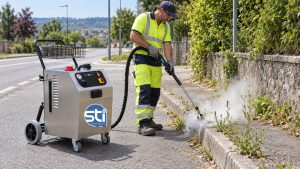
Taking care of a residential facility for elderly residents means protecting vulnerable people, with spaces used 24 hours a day and a continuous turnover of staff, families, and suppliers. This is why care home cleaning is no longer an ancillary activity: it’s part of the care pathway. Using steam cleaners allows raising the hygiene level, reducing environmental downtime, and containing the use of chemical substances that can leave residues or generate unpleasant odours.
Nursing home cleaning: hygiene priorities and main risks
A care home concentrates high-contact surfaces in both private and communal environments that consequently require particular attention. Handrails, handles, remote controls, bed control panels, keyboards, and phones are touched dozens of times per hour. Rooms, bathrooms, and common areas undergo intensive use, often without closure periods for maintenance interventions. Additionally, residents may have reduced immune defences or respiratory conditions that make the indoor environment crucial for their wellbeing.
Effective nursing home cleaning must therefore focus on three objectives: constant reduction of microbial load on “high touch” surfaces; management of high-risk areas (bathrooms, kitchens, infirmary, linen room) with adequate frequencies; protection of indoor air quality, avoiding harmful aerosols and chemical residues. Neglecting even one of these aspects can generate chain consequences: persistent bad odours, sticky surfaces that attract dirt, wet floors that increase fall risk, respiratory irritation in more sensitive residents. Dry saturated steam comes into play precisely here, with high-temperature physical action that attacks dirt and helps reduce microbial load without depositing additional substances.
Why choose dry saturated steam for nursing home cleaning
Dry saturated steam is a mixture of gas and microdroplets with very low moisture content. Delivered at high temperature and pressure, it transfers heat rapidly and uniformly, “dissolving” organic films, fats, and biofilms that detergents struggle to remove. And the advantages don’t end there!
The reduced moisture leaves surfaces almost dry after each pass: this means less waiting time to reopen rooms or let residents walk in corridors, with direct benefit to daily operations. Second aspect: penetration into microcracks and textiles. Steam reaches gaps, joints, seams, and material pores, where residues and odours accumulate. It’s precious help for armchairs, curtains, carpets, and mattresses, provided you respect distance, pass speed, and material compatibility.
Third point: reduction of chemical detergents. In many situations steam allows limiting the use of detergents and disinfectants to specific steps or particular cases, improving indoor air quality and residents’ olfactory comfort. This is particularly appreciated by those with hypersensitivity to fragrances and solvents. In sustainability terms, reduced water consumption and less need for disposable bottles make the process “cleaner” even upstream.
Fourth advantage: uniformity and repeatability. Correct usage technique (constant speed, pass overlap, contact time) makes the result less dependent on product choice or concentrations, an aspect that in facilities with staff rotations can make the difference.
Safety, materials and compatibility: the pillars of care home sanitization
Safety is played on three fronts: operator, resident, and material. The operator works with heat and pressure: firm grip, attention to jet direction, adequate working distances, and correct cloths are mandatory practices. Regarding residents, passage planning avoids conflicts and ensures safe, accessible areas in short times.
On the materials front, the rule is always test first in a small area then proceed with appropriate distances on woods, laminates, delicate fabrics, and tiles. Stainless steel tolerates steam well and benefits in terms of degreasing and shine, whilst in textiles – curtains, sofas, upholstered seating – using the suction function, present in steam cleaner & suction models, in combination with steam helps eliminate coarse dirt and sanitize in a single pass!
Service organization and staff training
Technology only works if integrated into solid organization. This implies mapping the facility into zones with differentiated priorities and frequencies, planning that considers peaks (meal times, visits, physiotherapy), and balanced workload distribution. Staff must be trained not only in machine use but in technique: pass overlap, contact time, cloth changes, surface reading.
Systematic recording – digital or on paper cards – is essential: it creates history, helps in periodic checks, and allows refining the protocol over time, for example increasing frequencies in a particularly busy corridor or intensifying passes on remote controls in rooms.

Steam applications for complete care home sanitization
Using dry saturated steam in care homes isn’t limited to common surfaces, but embraces practically every environment in the facility, with concrete advantages in terms of hygiene, intervention speed, and safety for residents and operators.
In bedrooms steam allows treating not only furniture and high-contact surfaces like handles, remote controls, and bed rails, but also floors, radiators, and mosquito nets, often difficult to clean thoroughly with traditional methods. Bathrooms, in turn, benefit from effective action on sanitaryware, showers, taps, joints, and glass, where heat removes limescale and biofilm without need for aggressive detergents.
In common areas, steam ensures rapid and safe cleaning of handrails, air conditioners, control panels, tables, and seating, returning usable spaces in short times. In kitchen and canteen it proves precious for degreasing and sanitizing steel surfaces, cold rooms, and equipment, in full compliance with hygiene sanitary protocols.
A further advantage, often underestimated, is steam’s ability to combat unwanted infestations: STI Steam Industry’s BugsBuster is an excellent solution against bed bugs, a problem that can occur even in residential environments like care homes and often leads to the need for pest control.
Steam therefore establishes itself as a versatile ally, capable of intervening in all facility departments, strengthening hygiene protocols and improving the quality of daily life for residents and staff.
STI Steam Industry: professional solutions for care homes
Integrating dry saturated steam into a care home sanitization protocol means adding efficiency, repeatability, and perceived quality. Thermal action helps remove “difficult” dirt, reduces product necessity, shortens downtime, and improves residents’ experience. The result is a more coherent care home sanitization system that supports operators’ daily work and strengthens the image of an attentive and modern facility.
STI Steam Industry supports facilities in choosing the steam generator most suitable for their specific needs. Our range is designed for professional use, with dedicated accessories, operator training, and after sales support. If you want to take care home cleaning to a higher level, improving restoration times and air quality, or if you have a cleaning company that handles care homes, STI Steam Industry solutions represent a reliable and proven standard for genuinely effective nursing home cleaning.
Contact us immediately for a quote or more information – it’s always a pleasure to help you! Are you more interested in joining the STI Steam Industry team? Check our page dedicated to distribution opportunities and actively take part in the steam revolution!
FAQ on steam cleaning in care homes
Usually times are short because dry saturated steam leaves surfaces almost dry. With good ventilation, a room can return to operation in significantly less time compared to high-humidity methods.
Yes, adopting correct nozzles and cloths, slow passes, and adequate distances.
By limiting chemical use and accelerating drying, steam contributes to a more neutral and pleasant environment. It’s often perceived as “cleaner” because it doesn’t leave persistent fragrances.
Professional dry saturated steam machines are designed to optimize water and energy. Overall consumption, considering restoration times and product reduction, is very competitive compared to traditional methods.