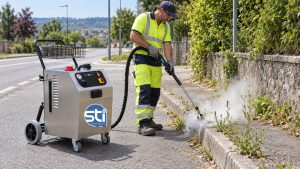
If you work daily with stainless steel, you know the real challenge isn’t just cleaning stainless steel, but doing it quickly, uniformly, without residues and, above all, without compromising the surface. In this guide we’ll try to sort through myths and quick tips (“vinegar everywhere!”, “bicarbonate on everything!”) and show you why dry saturated steam is, in many contexts, the most efficient and safe route for stainless steel cleaning on small and large surfaces.
Why stainless steel “stains”: understanding streaks, limescale and “false rust”
Stainless steel is protected by a very thin layer of chromium oxide. This passive film makes it resistant, but doesn’t make it “self-cleaning”. Streaks and stains appear when organic deposits (fats, oils, proteins), minerals (limescale), dust or ferrous contamination remain anchored to the surface.
Limescale streaks are typical in areas with hard water: during evaporation, mineral salts fix in micro depressions of the finish, leaving that opaque patchy effect. Grease – food or industrial – is tenacious because it creates a film that traps more dust, amplifying the opaque effect. Finally, orange spots mistaken for stainless steel rust sometimes appear: often it’s “false rust” caused by deposited ferrous particles (for example, from nearby mechanical work or unsuitable brushes). So how can we answer the question “how to clean stained stainless steel“? Simple, in all these cases effective sanitization is fought on two fronts: deep degreasing and dissolving/lifting dirt.
Things to avoid: why some products damage stainless steel
Bleach, detergents containing chlorides, acids or strong bases and aggressive abrasives (powders, steel wool) are shortcuts for cleaning stainless steel that you pay dearly for. Chlorides can favour corrosive phenomena and pitting; abrasives “open” the finish, creating micro-scratches that trap dirt and, over time, increase cleaning frequency. The result? Lost brilliance and stained and scratched steel.
If you’re wondering how to remove stains from steel without risk, the first answer is: avoid aggressive substances and tools that are too hard; the second is: use a method that dissolves dirt and carries it away without unnecessary rubbing. Can you think of one?
How to clean steel: why steam changes the rules of the game
Dry saturated steam is high-temperature steam with minimal water content (droplets almost absent). This means two fundamental things: it transfers heat very effectively – dissolving fats and reducing microbial load – and does not actually wet the surface, so dries instantly and leaves no streaks. For those who have tried procedures based only on detergents, the first impression is almost bewildering: the surface is clean and sanitized in a few passes, without sticky layers and without endless rinse cycles.
Heat softens and lifts grease films; thermal micro-expansion helps detach particles and light encrustations; the jet carries away residues that are collected with microfibre cloths or with combined steam + suction cleaners. In the case of limescale streaks, thermal action helps break down more superficial deposits and in more stubborn cases can be completed with targeted (non-abrasive) treatment or compatible pre-treatment, always followed by steam to eliminate residues.
The result is deeper, more uniform and faster steel cleaning. So when you’re looking for the best product for cleaning stainless steel, the most reliable answer isn’t a detergent, but steam cleaners.

Practical procedure: how to clean stainless steel with dry saturated steam
In any context the logic is the same. You prepare the area, choose the right accessory, work “with the grain” of the finish and finish with drying that’s often practically immediate. Let’s look at these steps one by one!
- Area preparation Ensure surfaces are free from bulky residues (crumbs, waste, etc.). Protect components sensitive to moisture or prolonged heat (non-heat-resistant seals, exposed electronics).
- Accessory selection Nozzles for edges, joints, bolts and grooves; soft brushes for large surfaces; lances with microfibre cloths for finishing. The objective is to maximise thermal contact without scratching the surface.
- Reasoned passes, not hurried ones Move the jet steadily and uniformly, following the direction of the satin finish. Unlike detergents, you don’t need to scrub hard: temperature does most of the work.
- Final check Observe in raking light: clean stainless steel “holds” light without streaks. If you see localised steel stains (usually limescale or old oil films), persist for a few seconds or repeat the pass with a clean cloth.
From kitchen to cellar, up to industry: real applications
- Catering and industrial kitchens (Ho.Re.Ca.) – Hobs, kitchen hoods, counters, industrial ovens and equipment: steam dissolves fats without residues, reducing streaks and downtime. Cleaning kitchen steel has never been so simple!
- Hotels & Resorts – Kitchen and back-of-house steel areas: rapid hygiene, also useful for wellness areas and beauty centres with many metallic surfaces.
- Healthcare – Trolleys, work surfaces, furniture and stainless steel handrails: effective sanitization without aggressive chemistry, in line with environments requiring high hygienic sensitivity.
- Food & beverage industry – Lines, tables, panels, conveyor belts and steel casings: support for HACCP procedures with removal of organic dirt and biofilm, almost immediate drying.
- Wineries (oenological sector) – Wine tanks in AISI 304/316, cisterns, pipelines and bottling lines: rapid and effective external and internal cleaning!
- General industry / chemical & cosmetic industry – Trolleys, machinery and panels (protected if sensitive): deep degreasing without abrasives, useful in maintenance and pre-inspection.
- Retail (supermarkets, shopping centres) – Counters, tills, shelving and display surfaces: constant hygiene even during opening hours, without residual odours.
Common errors that prevent professional results
- Too much haste. Steam needs seconds, not minutes to remove stains from surfaces: however if you “rush” too much, you don’t transfer enough heat to lift fats and biofilm.
- Saturated cloths. Microfibre should be changed often: an already loaded cloth redistributes residues and can create streaks.
- Wrong accessories. Hard or worn brushes can mark rather than polish. The rule is simple: better soft with more time under steam, than hard and fast.
- Unnecessary rinsing. Old habits die hard: if the result is clean and dry, there’s no need to introduce water you’d then have to remove.

How to clean stainless steel: who is STI Steam Industry and why we can help you
STI Steam Industry designs and produces steam generators for domestic, professional and industrial use. The focus is twofold: performance (temperature and steam quality for consistent results) and ease of use (accessories, ergonomics, steam/suction combinations). Whether you need to work on industrial kitchens, wine tanks, conveyor belts or machinery in production environments, the objective is to give you a system that simplifies the steel cleaning routine, reduces times and guarantees consistent results, shift after shift. Contact us for more information about our machines, we’ll be happy to recommend the one most suitable for your needs!
If instead you want to join our team and become part of our distributor network, fill out the form you’ll find on our dedicated page by clicking here!