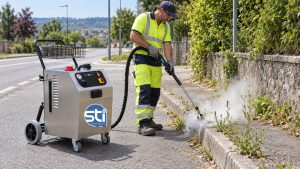
Understanding how to clean floor grout is one of the most common needs when you want to keep your home truly tidy, especially in the bathroom, kitchen and high-traffic areas. Tiles may look clean, but grout lines tend to trap dust, moisture, detergent residue, limescale and greasy dirt. The result is dark, dull or yellowed lines that ruin the appearance of an entire floor.
Many people search for grout cleaning products, home remedies or manual tools, but these methods do not always suffice. In some cases they require a great deal of time, effort and the use of harsh substances. Dry saturated steam, on the other hand, is a practical and deep-cleaning solution for cleaning grout lines because it works through heat, pressure and a very small amount of water.
Why do floor grout lines turn black?
Grout lines are the filler strips between one tile and the next. Unlike the smooth surface of a tile, they are often more porous, slightly recessed and therefore more exposed to the build-up of dirt. This is why floor grout cleaning requires a different level of attention compared to everyday washing.
- Dirt, dust and detergent residue: When you wash a floor with traditional products, some of the dirty water can settle into the grout lines. Over time, incompletely rinsed detergents, dust, organic residue and foot traffic leave a dark film.
- Moisture, mould and poorly ventilated spaces: Bathrooms, utility rooms and shower areas are environments where moisture encourages the appearance of dark patches and surface mould. In these cases, dirty tile grout is not just an aesthetic problem: it can trap unpleasant odours and make the surface less hygienic.
- Limescale and build-up in the shower: In the shower, limescale also comes into play. As water dries, it leaves mineral deposits that adhere to grout lines, glass, taps and tiles. This is why, when it comes to whitening grout, it is worth considering vertical surfaces and the shower enclosure as well, not just the floor.
How to clean tile grout: traditional methods and their limitations
Those searching for how to clean floor grout will often come across remedies based on bicarbonate of soda, vinegar, hydrogen peroxide, bleach or specialist detergents. Some can be useful in mild cases, but they are not always suitable for every surface.
- Bicarbonate of soda, vinegar and hydrogen peroxide: These are among the most commonly cited remedies for whitening floor grout or treating surface stains. However, they require soaking time, scrubbing and careful rinsing. In addition, acids and oxidising substances may not be suitable for some materials or finishes.
- Bleach and aggressive products: Grout cleaning products based on bleach or very strong agents can produce a rapid visual effect but do not always solve the problem at the root. They can discolour some surfaces, leave strong odours and require careful use, particularly in enclosed spaces.
- Brushes and elbow grease: A brush can be useful but must be chosen with care. An overly abrasive accessory can wear down the filling material, especially if the grout is old or crumbly. For anyone looking for how to clean floor grout without effort, a brush is certainly not the most suitable option.

Cleaning grout with dry saturated steam: how it works
Dry saturated steam is particularly effective for floor grout cleaning because it allows targeted work in the gaps with a focused jet. The heat helps to dissolve dirt, while the pressure helps to loosen residue and deposits from the hardest-to-reach areas. Instead of soaking the floor thoroughly, steam works with a reduced water input. This is important when treating indoor areas, bathrooms, kitchens or surfaces that need to dry quickly. In most cases, it also allows for a reduction in chemical detergent use, making grout cleaning more sustainable and practical.
- Heat dissolves ingrained dirt: Grout accumulates deep-seated dirt. Steam, thanks to its high temperature, helps to dissolve grease, soap residue, compacted dust and organic matter. This makes it easier to clean tile grout without having to work too hard with stiff brushes.
- The jet reaches even the narrowest areas: With concentrator nozzles, steam lances and dedicated small brushes, a steam generator can work with precision along the lines between tiles and is useful for treating difficult spots such as corners, edges, skirting boards and bathroom joints.
- Less water, fewer detergents, greater practicality: Compared to traditional washing, steam allows for more controlled moisture management. This is especially useful for floor grout cleaning in occupied spaces, hospitality venues, professional premises or contexts where the surface needs to be put back into use quickly.
Cement grout, epoxy grout and silicone: not all are cleaned the same way
Before choosing the most suitable method for cleaning floor grout, it is important to assess the type of material. Cement grout is generally more absorbent and tends to get dirty more easily. Epoxy grout is more compact and resistant, but still needs to be treated carefully. Silicone, on the other hand, is not a true grout: it is found mainly in shower corners or along sanitary fittings and, when very damaged or deeply blackened, replacement may be necessary rather than cleaning.
How to clean floor grout: practical procedure with steam
To achieve a good result, floor grout cleaning with steam requires a few simple but precise steps. The important thing is not to use the lance as if it were a tool to press hard against the grout. There is no need to push with force or scrub aggressively: it is steam that dissolves the dirt through controlled heat and pressure. This way, cleaning grout with steam does not become a tiring task but a targeted, progressive intervention. Only where heavier deposits are present can a suitable small brush support the action of the steam, without applying excessive pressure.
- Remove dust and surface dirt – Before starting, it is useful to vacuum or sweep the floor. This allows the steam to focus on the dirt in the grout lines, without dragging dust across the surface.
- Direct the jet along the grout line – Steam should be directed following the line between tiles, with slow and controlled movements. There is no need to flood the area, and the lance should not be pressed against the grout: it is the heat that makes the difference, gradually dissolving the accumulated dirt.
- Use targeted accessories only when needed – Concentrator nozzles and small brushes help to clean grout between tiles with greater precision. A small brush can be useful on heavier deposits, but should be used as support for the steam action, not as a tool for aggressive scraping.
- Collect the loosened dirt and dry – After the steam pass, the dirt should be removed with a clean cloth or, on models equipped for it, with integrated vacuuming. Steam cleaners with a vacuum function are particularly convenient as they help to vacuum and dry the treated surface, reducing both time and residue.
How to whiten shower tile grout with steam
The shower is one of the most delicate areas when it comes to home sanitisation. Here, grout lines are exposed every day to water, soap, shampoo, limescale and moisture. This is why many searches about how to clean grout concern the shower enclosure specifically, where dirt tends to build up not only on the floor but also on the walls, in the corners and along the rim of the shower tray.
Steam can be used on tiles, grout lines and compatible surfaces to dissolve soap residue, dirt and limescale. It is also useful in spots where sponges and cloths struggle to reach, such as joints, edges, recesses and areas close to the taps. Where surface mould is present, the heat helps to sanitise the area and remove the visible discolouration; however, if the silicone is deeply compromised, cleaning alone may not be enough and replacement may be necessary.
The same logic applies to many other bathroom surfaces. A steam generator can be useful for treating sanitary fittings, washable surfaces and difficult spots, always checking material compatibility. This is why, when it comes to how to clean the bathroom with steam, shower grout is just one of many possible applications: steam allows targeted intervention precisely where dirt, moisture and limescale tend to accumulate most easily. In the bathroom, dirt also spreads to glass, mirrors, taps and wall tiles. Steam can help treat the shower enclosure, especially where there are water marks, soap residue and moderate limescale build-up. When carrying out glass cleaning with steam, it is important to dry immediately with a suitable cloth or squeegee to limit the formation of streaks.
The same approach becomes even more useful in high-traffic settings such as gyms, fitness centres, swimming pools and changing rooms. In these environments, grout on floors and wall tiles is exposed every day to moisture, sweat, detergent residue, limescale and continuous foot traffic. For those managing a sports facility, steam cleaning allows targeted intervention on showers, changing rooms, bathrooms, floors and washable surfaces, helping to keep spaces more hygienic and pleasant.

STI Steam Industry: steam generators for grout, floors and bathrooms
STI Steam Industry develops steam generators designed for the cleaning and sanitisation of domestic, professional and industrial environments. For those who need to manage floor cleaning, steam is a versatile technology because it allows work on compatible surfaces, grout lines, corners and difficult spots with a more thorough approach than traditional washing.
For domestic use, the Domestic Line offers practical solutions such as QV7 and Pratika. QV7 is suited to those looking for a steam and vacuum generator: thanks to the Dry-Master technology, it vacuums and dries the treated surface, while the INFINI-VAC system allows suction power to be adjusted according to the type of work. In addition, the QV7 incorporates the VAP Filter System, a technology patented by STI that pairs a steam filter with the standard water filter, helping to trap fine dust, pollen and dust mites in the vacuumed air. Pratika, compact and easy to handle, is suited to domestic cleaning where effective support is needed for floors, bathrooms and compatible washable surfaces; here too, the Dry-Master technology helps to collect the dirt loosened by the steam and leave surfaces drier.
For more demanding environments, hospitality venues and hotels, cleaning companies, offices or small businesses, the Professional Line offers models such as QV7 PRO and Comby 3000. QV7 PRO combines steam, vacuum and detergent management: in addition to Dry-Master and INFINI-VAC, it incorporates the Dose-Master technology, which is useful for adjusting the optional steam/detergent mixture when the type of dirt requires it. The QV7 PRO also features the VAP Filter System, a particularly relevant aspect in environments such as bathrooms, changing rooms, hotels and professional spaces where hygiene and air quality matter. Comby 3000, on the other hand, is designed to wash, sanitise and dry in a single pass; its stainless-steel body with Steel-Master technology makes it a robust solution for professional settings, while Flow-Master allows steam flow to be managed according to the surface being treated.
Contact STI Steam Industry to identify the steam generator best suited to cleaning grout, floors, bathrooms and compatible surfaces. If you are interested in joining the steam revolution, visit our dedicated page on distribution opportunities!
FAQ on how to clean tile grout
Yes, steam can help dissolve ingrained dirt in grout lines and remove superficial dark marks. If the grout is very worn, deeply stained or deteriorated, cleaning can improve its appearance but may not fully restore the material.
Bicarbonate of soda can be useful for light soiling, but requires scrubbing and rinsing. Steam works through heat and pressure, reduces detergent use and can make it easier to clean floor grout and tiles without excessive effort.
On intact grout lines and compatible surfaces, steam can be used correctly. It is best avoided, or used with great care, on crumbled, detached or very old grout, or on delicate materials not suited to high temperatures.
Yes, steam is useful for grout lines, corners, tiles and compatible shower enclosures. It helps to treat soap residue, moisture and limescale. After treatment, it is always advisable to dry the surfaces thoroughly.
To clean porcelain stoneware floor grout, it is useful to first remove dust, run steam along the grout lines and collect the loosened dirt with a cloth or by vacuuming. It is important to avoid waxy or overly aggressive products that could leave residue in the grout lines.