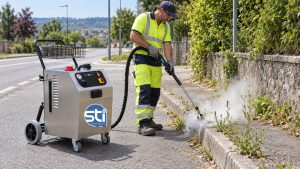
Lubricating oils, greases, emulsions, dusts, swarf, release agents and production residues tend to accumulate on housings, frames, belts, moulds and the accessible components of machinery. If they are not removed regularly, they can make inspections more difficult, slow down changeovers, conceal leaks and compromise order in the working area. Among the techniques available for degreasing and cleaning industrial machinery, dry saturated steam makes it possible to combine heat, jet pressure and the action of dedicated accessories using a contained amount of water. It is particularly useful when complex geometries and greasy soiling need to be treated without flooding the area.
What residues accumulate on industrial machinery?
La natura dello sporco cambia in base al processo produttivo. Nell’industria meccanica prevalgono oli interi o emuThe nature of the soiling varies according to the production process. In the mechanical engineering industry, the main contaminants are neat or emulsifiable oils, greases, metallic dusts and swarf. In plastics processing, one typically encounters release agents, pigments, dusts and thin deposits of polymeric material. In the automotive sector, lubricants, adhesives, sealants, machining residues and contaminants carried along production lines may all be present simultaneously.
Industrial machinery cleaning generally has to deal with four main categories of contaminant:
- Greasy and oily residues, which trap dust and make surfaces slippery;
- Solid residues, such as swarf, fibres, dusts, granules and off-cuts;
- Adherent deposits, including adhesives, release agents, paints, inks and carbonised material;
- Mixed soiling, often the most challenging, comprising oil, fine particles and dried-on residues.
Identifying the type of contaminant helps in selecting the right temperature, flow rate, working distance and accessory — avoiding the risk of simply redistributing the soiling or removing technical lubricants that need to remain in place.
Why use dry saturated steam for industrial degreasing?
In industrial degreasing, the thermal energy of steam helps to lower the viscosity of oils and greases, facilitating their release from the surface. The jet reaches grooves, joints, grilles, edges and areas where sponges or manual methods struggle to work effectively. The softened soiling can then be collected using technical cloths, brushes or steam with vacuum extraction, rather than being spread across the surface.
Compared with a high-volume wash, machinery cleaning with steam limits the amount of water introduced and the volume of effluent to be managed. It is useful where drains are not immediately accessible, on sensitive floors and for localised interventions. It can also reduce reliance on aggressive solvents, making solvent-free industrial cleaning a realistic option for many routine tasks. On particularly stubborn deposits, a compatible detergent can still be used, dosed only where genuinely necessary.
The main advantage lies in precision: small treatment zones, adjustable flow, complex geometries and rapid collection of residues.

How to clean industrial machinery with steam
1. Assess the machine, materials and critical points
Before starting, it is essential to identify compatible surfaces, electrical components, sensors, seals, bearings, lubricated guides, and any holes or gaps where moisture must not penetrate. The machine must be stopped and made safe. Electrical panels, connectors, motors, encoders and unprotected components must not be directly exposed to the steam jet.
2. Remove coarse soiling first
Swarf, granules, off-cuts and dust must be collected before treatment begins. Otherwise they can form a paste that is difficult to dislodge and that prevents the jet from acting directly on the grease film.
3. Work on small areas at a time, using the correct accessory
Concentrated lances and narrow nozzles are suitable for accessible joints and cavities; brushes help combine thermal and mechanical action; wider nozzles are useful on housings and panelling. The working distance should be sufficient to dissolve the soiling without stressing the surface; on sensitive materials, it is advisable to increase intensity gradually.
When residues need to be removed immediately, a steam with vacuum extraction system makes it possible to collect dissolved soiling and residual moisture simultaneously. This approach is particularly useful on horizontal surfaces, trays, guards and areas where contamination running freely would be undesirable.
4. Inspect, dry and restore protective measures
Once cleaning is complete, it is important to inspect the collection areas, dry any critical points and restore any protective coverings or lubricants as required. Oils, emulsions and collected materials must be handled in accordance with site procedures. The machine may only be returned to service after the area and the components involved have been inspected.
Steam cleaning applications across key industrial sectors
Industrial machinery cleaning varies considerably depending on the production process, the materials being worked and the nature of the residues to be removed. The advantage of dry saturated steam lies precisely in the ability to tailor the treatment, intervening in a targeted manner on surfaces, components and equipment without necessarily resorting to high-volume washing or the systematic use of solvents. The combination of thermal action, jet pressure and specific accessories makes it possible to soften adherent soiling, reach complex geometries and treat points that are difficult to clean by hand.
Mechanical engineering: machine tools, presses and machining centres
In mechanical workshops, turning and milling departments and metal processing facilities, machine tool cleaning primarily has to contend with neat oils, coolant emulsions, greases, metallic dusts and fine swarf that tend to build up over time in layers. Steam promotes the removal of cutting oils and grease films that trap metal particles and dust. The heat reduces their viscosity, while the jet helps to release them from the surface. Concentrated lances and nozzles also make it possible to reach edges, joints, grilles, external guides and gaps that would take far longer to address with cloths and conventional detergents.
The same approach can be applied to presses, assembly benches, clamping fixtures, guards and components that need to be degreased before a subsequent process stage. A clean surface facilitates operations such as dimensional inspection, assembly, painting or bonding — provided the treatment is configured according to the requirements of the process. Keeping housings and technical surfaces clean also offers a diagnostic advantage: leaks, seepage, wear and abnormal deposits are far easier to identify when they are not concealed beneath layers of oil and dust, making cleaning a concrete support tool for inspection and preventive maintenance activities.
Automotive: production lines, tooling and components
In the automotive sector, technical machinery cleaning concerns manufacturing plants, OEM departments, component suppliers and assembly lines. This is therefore a distinct application from car detailing, which involves cleaning the finished vehicle. In an industrial context, the objective is to keep tooling, handling systems and the surfaces involved in the production process operating efficiently.
Machinery degreasing may be required on jigs, fixtures, frames, presses, guards, roller conveyors and support structures on which oils, greases, adhesives, sealants and machining residues accumulate. Steam makes it possible to intervene in a localised manner, treating only the affected zones without distributing large quantities of water across the entire line. This is particularly valuable during maintenance windows, at changeovers or when the cleanliness of a specific piece of equipment needs to be quickly restored. Extended lances and directional accessories allow substructures, crevices, fixing points and areas that are difficult to clean manually to be reached. Where the system incorporates vacuum extraction, the softened soiling can be removed at the same time, limiting residue falling onto adjacent surfaces.
Steam can also be used for degreasing metal components and bare bodywork, but the procedure must be verified against the requirements of the subsequent process stage. Prior to painting, bonding or the application of coatings, the surface must meet precise cleanliness and preparation specifications. For this reason, the treatment must always be validated within the production process.
Plastics: mould, press and extruder cleaning
In plastics processing, residues of release agent, pigments, dusts and polymeric material can accumulate on moulds and on the external areas of machinery. If not removed, these deposits can interfere with the finish of parts, increase set-up times and make inspection and maintenance more difficult.
Steam mould cleaning can be an effective solution for treating accessible surfaces, edges, simple cavities, parting surfaces and areas where release agents or fine residues tend to collect. The thermal action helps to soften contaminants, while nozzles and brushes allow more precise intervention compared with a general wash. The main advantage is the ability to limit solvent use and reduce the amount of water introduced, particularly for routine maintenance tasks.
Packaging, rubber, textiles and other industrial sectors
Steam cleaning applications extend across many other sectors as well. On packaging lines, frames, accessible rollers, guides, guards and surfaces affected by adhesives, lubricants, paper dusts or product residues can all be treated. In the rubber industry, steam can contribute to the removal of release agents, oils and adherent residues from compatible equipment and surfaces. In the textiles sector, cleaning may cover frames, structures, housings and areas where fibres, dust and lubricants accumulate. The adjustable jet flow allows the treatment to be tailored to the sensitivity of the materials involved, avoiding unnecessarily aggressive intervention.
Handling systems deserve particular attention. Belts, rollers and conveyors collect residues throughout the production cycle and can transfer them from one stage to the next. For these applications, it is worth exploring steam cleaning of conveyor belts in more detail, always assessing material compatibility, temperature and the method of soiling collection.
Individual machine cleaning is most effective when it forms part of a coordinated approach to managing the entire department. Addressing surfaces, equipment and operational areas as well helps to preserve results for longer and to improve cleaning in general industry overall. In the same way, proper industrial building cleaning helps to reduce the presence of dusts and contaminants that could settle back on equipment. Industrial machinery cleaning thus becomes part of a broader plan oriented towards order, maintenance, process control and production continuity.

STI Steam Industry: steam generators for industrial machinery cleaning
STI Steam Industry develops steam generators for professional and industrial applications, designed to treat the surfaces, components and equipment affected by oils, greases and production residues. In industrial machinery cleaning, the ability to adjust the output and use lances, brushes and other accessories connected to the generator’s flexible hose makes it possible to reach housings, frames, joints, guides and points that are difficult to access by conventional manual methods.
For localised interventions or departments where a three-phase power supply is not available, the Professional Line includes models such as the Gaiser 4000 and the Comby 3500. Both allow the treatment to be adapted to operating conditions through FlowMaster, which regulates the steam flow; DoseMaster, which doses detergent where required; and Hydro-Jet, useful when the process calls for an additional water input to aid rinsing.
The key difference lies in how the loosened soiling is managed. The Gaiser 4000 is a single-phase steam-only generator, suited to situations where oils, greases and emulsions are subsequently collected with technical cloths or separate systems. The Comby 3500 incorporates vacuum extraction: DryMaster technology removes residues and moisture from the treated surface, while Infini-Vac allows suction power to be adjusted. This configuration is particularly useful on machine tools, housings, trays and production equipment where it is important to prevent run-off and contamination spreading to surrounding areas.
For continuous use and more demanding applications, the Industrial Line offers three-phase generators with stainless-steel construction and greater steam output. The Gaiser 6000, Gaiser 9000 and Gaiser 18000 are designed for applications requiring intense, sustained output, with separate soiling collection. The choice between the three models depends primarily on the extent of the surfaces involved, the frequency of interventions and the steam volume required by the process. The optional HydroPower technology connects the generator directly to the water mains, making it easier to sustain extended working sessions without frequent manual refilling. Controlled detergent dosing and the ability to integrate rinsing also make it possible to tackle particularly adherent residues without using more product than strictly necessary.
When machinery degreasing requires soiling to be dissolved and collected within the same operational cycle, the Comby 6000 and Comby 9000 combine the power of the three-phase range with adjustable vacuum extraction. They are therefore well suited to large surfaces, multiple pieces of equipment or departments requiring frequent cleaning, where the immediate removal of oily residues helps to keep the work process more orderly and controlled.
Contact STI Steam Industry to identify the most suitable steam cleaner, accessories and configuration for the technical degreasing of machinery in your facility. If you are interested in joining the STI network, visit the page dedicated to distribution opportunities.
FAQ on industrial machinery cleaning
Steam is particularly effective on oils, greases, coolant emulsions, adherent dusts, release agents and machining residues. The result depends on the consistency of the soiling, the material of the surface and the accessory used.
The heat helps to soften oily residues, while the pressure of the jet facilitates their release even from joints, edges and areas that are difficult to reach with cloths or manual brushes.
Steam uses less water and enables a more localised action on fine details and gaps. A pressure washer is better suited to large, robust surfaces and areas with drainage, but generates considerably more wash water.
It depends on the machinery. Steam can reduce the level of dismantling required to reach certain accessible areas, but guards and components must be removed or isolated where specified by the maintenance manual and the maintenance plan.