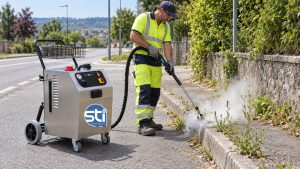
Silo cleaning is one of the most critical operations in industrial processes, particularly in the food and beverage, wine, pharmaceutical and chemical sectors. Silos, tanks and cisterns are the nerve centres of production: inside them accumulate raw materials, semi-finished goods and residues which, if not properly managed, can compromise the quality of the end product and the safety of the entire plant. In recent years, advances in technology have led a growing number of businesses to move beyond traditional methods, adopting advanced systems such as steam cleaners for tank cleaning, cistern cleaning and the deep sanitisation of surfaces. This approach not only improves the effectiveness of cleaning operations, but also reduces the use of chemical substances and the overall environmental footprint.
Why is silo cleaning indispensable in industrial processes?
Inside a silo or cistern, residues are never merely a cosmetic concern. They can generate microbiological contamination, compromise organoleptic properties and even create structural risks. This is especially true in food manufacturing, where quality and safety are non-negotiable. In this context, proper cleaning management is an integral part of HACCP protocols and plays a key role in preventing cross-contamination. It is no coincidence that many food manufacturers adopt specific solutions to ensure high standards and uninterrupted production. Similar considerations apply to more technical sectors, such as general industry, where these activities form part of a broader programme of industrial maintenance and hygiene.
How often should silos, cisterns and tanks be cleaned?
Determining the correct frequency of cleaning is essential. There is no universal rule, but a number of factors help identify when to intervene: the type of product stored, dwell time, ambient conditions and the level of automation of the plant all directly influence cleaning requirements. In the food and beverage sector, containers and plant equipment are sanitised frequently — often at every product changeover or at the end of each production cycle. In other industrial settings, cleaning may instead be scheduled periodically based on throughput volumes.
In the wine industry and in the context of winery sanitisation, hygiene management follows well-defined cycles, with interventions that may be daily during the most critical phases. In particularly sensitive environments such as the cosmetics industry or the pharmaceutical industry, protocols are even more stringent and require validated, documented procedures after every batch.
The limitations of traditional cleaning methods
Traditional systems are often based on high-pressure water washing or the use of chemical detergents. Although still widely used, they come with several significant drawbacks. High-pressure water may not be sufficient to remove greasy residues or complex encrustations, particularly where complex geometries or hard-to-access internal surfaces are involved. Furthermore, heavy water usage generates large volumes of effluent that must be managed, with a direct impact on operating costs.
Chemical products, meanwhile, involve costs, health risks for operators and potential residues on surfaces. This is a particularly critical consideration in the food and pharmaceutical sectors, where even minor contamination can compromise the quality of the end product. A further limitation is the difficulty of ensuring consistent cleaning across all internal surfaces. In the case of materials such as stainless steel, widely used in storage systems, it is essential to adopt techniques that do not damage the finish over time.
Cleaning silos and cisterns with steam: how it works
The use of steam cleaners today represents one of the most effective solutions for industrial cleaning and sanitisation. The principle is based on the use of dry saturated steam — characterised by high temperature and low moisture content — which transfers thermal energy with extraordinary efficiency. This enables grease, organic residues and encrustations to be dissolved, even penetrating the micro-pores of surfaces.
At the same time, the high temperature eliminates bacterial loads, moulds and micro-organisms, delivering genuine sanitisation without the use of chemical substances. Low water consumption and minimal drying times make this system particularly well suited to production environments where continuity and safety are paramount. In the brewing sector, for example, brewing equipment sanitisation requires precise treatment of fermentation vessels and pipework to prevent any alteration to fermentation processes or aromatic profiles.
The benefits of steam in industrial cleaning
To summarise, the use of steam generators delivers concrete, measurable benefits:
- Deep sanitisation without chemical products
- Reduced plant downtime
- Minimal water consumption
- Greater operator safety
- High application versatility

Applications: from silos to fermentation vessels and autoclaves
The versatility of steam finds concrete expression in professional steam cleaners — purpose-built tools designed to improve the effectiveness of silo, tank and cistern cleaning across a wide range of industrial settings. The use of steam-powered machinery speeds up cleaning processes, reduces the need for detergents and achieves deeper sanitisation even in hard-to-reach areas.
Food and beverage: certified hygiene and HACCP protocols
In the food sector, cleaning is closely tied to compliance with HACCP protocols and regulatory requirements. Steam cleaners enhance sanitisation processes by treating conveyor belts, tanks, silos and processing surfaces. The combined action of temperature and pressure eliminates pathogens, bacteria and organic residues without chemical products, improving food safety, preventing cross-contamination and reducing waste associated with traditional washing methods. The speed of intervention also supports production continuity.
Pharmaceutical and cosmetics: controlled, residue-free sanitisation
In the pharmaceutical and cosmetics sectors, cleaning must meet extremely rigorous standards, particularly within controlled environments and cleanrooms, where even minimal contamination can compromise product quality and process integrity. Steam cleaners therefore represent an effective solution for cleaning autoclaves, reactors, tanks, production lines and technical surfaces, as they deliver deep sanitisation without leaving chemical residues.
Steam action is particularly valuable in regulated processes, where cleaning procedures must be repeatable, verifiable and fully documented. The use of steam machinery delivers consistent results, improves hygiene management in production areas and reduces the risk of cross-contamination between batches. This characteristic is fundamental in the pharmaceutical industry, where microbiological control is integral to quality assurance, and equally important in cosmetics, where thorough equipment cleaning helps preserve the purity of formulations and ensure compliance of the finished product.
Chemical industry: effective removal and reduced solvent usage
In the chemical industry, cleaning cisterns and tanks is a critical phase, particularly during batch changeovers, where it is essential to prevent any cross-contamination between different production runs. The complete removal of reactive residues and deposits is indispensable for ensuring process safety and eliminating substances that could interfere with or react to subsequent compounds, compromising product quality and reaction stability. Steam cleaners also enable the effective dissolution and removal of encrustations, complex residues and difficult stratifications, limiting operator exposure to aggressive substances and simplifying maintenance operations, even on complex and hard-to-access equipment.
Wine industry: product quality and continuous sanitisation
In the wine industry, steam cleaning is an integral part of day-to-day winery management. Steam cleaners help maintain high hygiene standards throughout the entire production chain — from the cleaning and sterilisation of glass bottles to the maintenance and cleaning of wooden barrels, through to the sanitisation of fermentation vessels and storage cisterns for wine and raw materials — without damaging materials or leaving residues. Thanks to their effectiveness, steam cleaners help prevent microbiological contamination, preserving the organoleptic characteristics of the wine and ensuring consistently clean, controlled environments.

Steam silo cleaning solutions: contact STI Steam Industry
If you are looking for an effective, forward-thinking solution for cleaning silos, cisterns, tanks, autoclaves or fermentation vessels, the steam cleaners of STI Steam Industry represent an advanced benchmark for industrial applications. Designed to deliver outstanding performance even in the most demanding settings, these systems achieve deep sanitisation, reduce plant downtime and minimise the use of chemical products. The industrial range is built for intensive, continuous use — ideal for production plants where reliability and power are non-negotiable:
- Gaiser 6000 and Gaiser 9000, compact yet powerful steam generators, ideal for frequent cleaning of silos, tanks and production lines
- Gaiser 18000, a high-performance solution designed for intensive use on large volumes and complex plant configurations
- Comby 6000 and Comby 9000, versatile systems combining steam power and vacuum extraction for industrial cleaning
To further enhance sanitisation effectiveness, STI Steam Industry offers a range of accessories designed for specific applications:
- Long lance — 450 mm: ideal for reaching deep points inside silos and cisterns, ensuring greater working distance and precision even in the least accessible areas. Designed specifically for the food and mechanical industries; the rubber section can be removed from the nozzle to attach threaded brushes.
- Ø28 mm brass brush: on stainless-steel surfaces, the brass brush leaves no foreign residues and does not scratch (because, even though it is metallic, the bristles are softer than steel). Perfect for removing encrustations and organic residues from the internal walls of containers. The 28 mm diameter is ideal for welds, joints and the narrow spots typical of silos.
- Industrial flat-surface accessory: designed for the rapid, uniform treatment of smooth, broad internal walls of tanks and silos, optimising intervention time on large surfaces. Connects to the Hydro handle and can be paired with extension tubes to reach even the most distant points.
- Steam nozzle with 3.5 mm bore: mounts directly onto the Hydro gun, delivering a powerful, concentrated jet of steam for tackling stubborn encrustations.

Thanks to the combination of high-performance industrial machines and dedicated accessories, STI Steam Industry’s equipment represents a comprehensive solution for improving the efficiency of cleaning operations and maintaining high hygiene standards in any production environment.
Contact STI Steam Industry for further information or a personalised quotation tailored to your production requirements. If you are interested in entering a sector characterised by strong growth and innovation, find out about our collaboration and distribution opportunities and become part of our network.
FAQ on cistern and silo sanitisation with steam
Yes. In silo cleaning, dry saturated steam is particularly effective on organic residues, grease and encrustations because it dissolves dirt and penetrates surfaces, reaching even the least accessible areas.
Yes, steam cleaning of fermentation vessels is ideal because it eliminates biofilm, yeasts and residues without leaving any trace, ensuring optimal hygienic conditions between production cycles.
Yes, steam autoclave cleaning is particularly well suited to pharmaceutical applications because it achieves high levels of sanitisation without introducing chemical substances into the process.
No. Steam cleaning is especially well suited to stainless-steel surfaces because it is non-abrasive and requires no aggressive chemical products. This preserves the finish and keeps surfaces smooth, reducing dirt adhesion over time and making subsequent cleaning operations easier.
Silo cleaning times with steam cleaners are generally shorter than with traditional methods, because steam dissolves dirt and sanitises in a single phase. Duration depends on size, type of residue and soiling level, but in most cases it is possible to significantly reduce both intervention times and plant downtime, improving the overall efficiency of the process.